All Women’s Sports Network (AWSN), the women’s sports network co-founded by Whoopi Goldberg, has announced that Her Royal Highness Princess Reema Bandar Al-Saud will join the network in a formal advisory role.
The appointment comes as AWSN prepares to move beyond broadcasting in the GCC. Speaking exclusively to The Mettleset, AWSN’s leadership revealed plans to launch Her, a series of live international women’s sports events, in Saudi Arabia and the United Arab Emirates in 2027, alongside a schools programme, camps and clinics with international coaches, and a women’s sports summit.
Currently serving as the Kingdom of Saudi Arabia’s Ambassador to the United States, the first woman to hold the role, Princess Reema has long been a champion of women’s sport both at home and abroad. Since 2016, she has held numerous senior public service roles in the Kingdom focused on women’s and inclusive sport with organisations that include the Saudi General Sports Authority, the Mass Participation Federation — where she became the first woman to lead a multi-sport federation in Saudi Arabia — and the Saudi Olympic and Paralympic Committee. She is also Honorary President of the Saudi Special Olympics and a board member of the Sports for All Federation and Mahd Sports Academy.
On the international stage, Princess Reema is an active member of the International Olympic Committee (IOC), where she serves on the Gender Equality, Diversity & Inclusion Commission, the Sustainability and Legacy Commission, and the Coordination Commission for the Brisbane 2032 Olympic Games.
For AWSN co-founder and CEO George Chung, Princess Reema’s appointment matters far beyond the Kingdom: “Her work in the region is so important because it gives a powerful voice and advocacy to the mission. Not only the mission of [Vision] 2030, but the mission that we align ourselves with, which is to grow women’s sports on a global level. And truly what she’s doing in the region has effect globally.”
“She talks the talk and walks the walk,” he added.
AWSN Chairman Nasser Kazeminy said in a statement that the network is “deeply honoured” to welcome Princess Reema, adding: “Her vision for what sport can mean for women and young girls extends far beyond competition. It is about visibility, opportunity and possibility. Together, we have an opportunity to reimagine how women’s sports are presented to the world and, importantly, how that visibility can inspire new opportunities for women throughout Saudi Arabia and the Middle East.”
Chung said that on her first call with the team, Princess Reema told them she was “so proud of what AWSN has done for Saudi women’s football,” referencing the deal that saw AWSN begin airing the SAFF Saudi Women’s Premier League in September 2025, both inside the Kingdom and globally, with a prime-time league match every week. Launched in 2022, the league is now into its 2026/27 season, with eight clubs competing for the title across 56 matches. Players from 26 nationalities account for approximately 26% of the league, and according to data released in 2025, 44% of Saudis say they follow the league.
“Were You Talking to Women?”
AWSN first launched in the GCC in November 2024 in the United Arab Emirates, followed by Saudi Arabia in September 2025, and is available on StarzON and MBC Shahid respectively. While relatively new, the network itself has been a long time coming. Goldberg first had the idea 17 years ago, with a vision “to bring women’s sports from around the world to women around the world to make it highly accessible,” Chung said. She was turned down and was told nobody would watch. “I always go back and say, ‘Yeah, but were you talking to women?'”
Chung met Goldberg about three years ago, and his company, JungoTV, went on to co-found AWSN with her. Today, he said, it is “the largest women’s sports network in the world by virtue of content, carriage,” with “live sports coverage in nearly 17 different sports with over 30 different leagues and federations.” Beyond the GCC, AWSN’s carriage partners include Amazon Prime Video and Pluto TV in the US and UK, SuperSport across Africa, Jio in India, and Tamasha and Toffee in Pakistan and Bangladesh. In the US alone, Chung said, viewership is “now amounting in hundreds of millions of views in a year.”
The partnership that saw AWSN launch in the Kingdom came through Othman Shoukat and his company, PowerPlay, which leads much of AWSN’s distribution in the region through its relationship with MBC. For Shoukat, taking the Saudi Women’s Premier League global was a standout moment: “What made this really notable was the fact that we’re taking a local league and we’re actually broadcasting on a global level.” Shoukat linked the deal to Vision 2030 and the Kingdom’s upcoming hosting of the 2034 World Cup, saying it was “really, really closely aligned with the vision that the Kingdom has.”
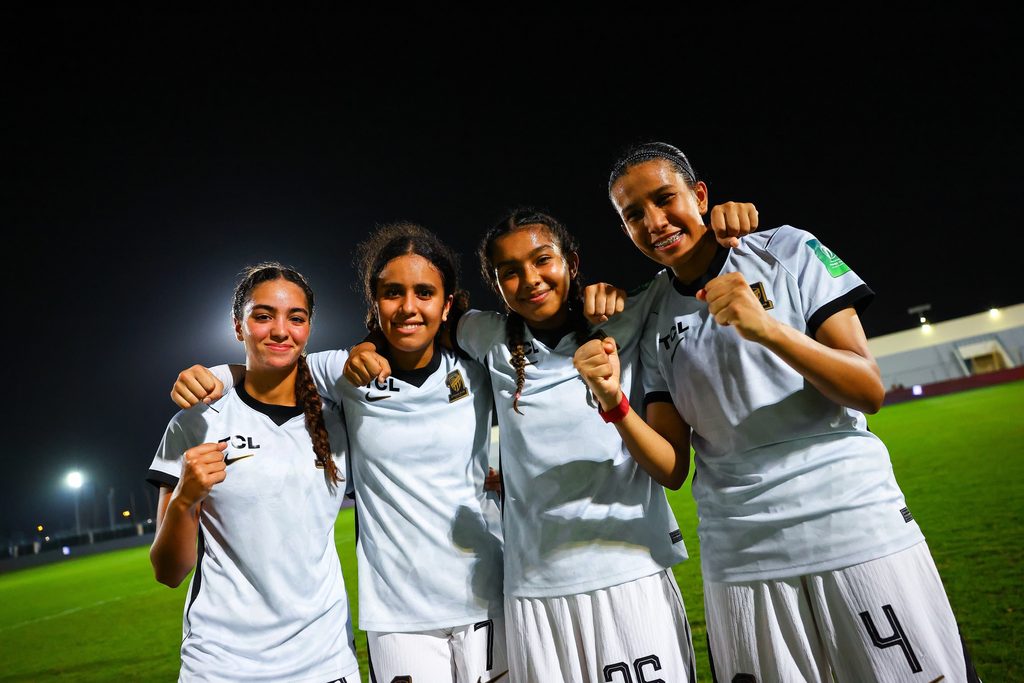
For audiences abroad, Chung said, seeing the Saudi league’s production values next to Europe’s biggest clubs changes perceptions: “This isn’t minor league, this is major league football.”
Beyond the Screen: Introducing Her
AWSN’s plans for the GCC go further than broadcast. The network revealed to The Mettleset that in 2027 it will launch Her, a live-event platform with editions planned in both Saudi Arabia and the UAE (Her Arabia and Her Emirates), before expanding across the MENA region.
“This is so much bigger than bringing women’s sports to more screens,” Chung said in the announcement. “This is a platform where a young girl in Riyadh, Dubai, Dhaka or Lahore, London or Los Angeles can see extraordinary women competing at the highest level, see what is possible, and know there is a place for her in sport. That is the future we are building at AWSN.”
The ecosystem, Shoukat explained, is “not just about having a TV product” but about “having engagement at a grassroots level,” connecting participation, competition and visibility in “this kind of perpetual cycle.”
Her will feature elite international women’s competition in football, cricket, volleyball and tennis, with local and regional teams represented, competing alongside teams from the UK, Europe and the US.
“The ecosystem will be lifted and built together,” added Shoukat.
Around the competition, AWSN also plans to build Her Futures, a schools programme to drive participation, along with camps and clinics led by international coaches. There will also be Her Summit, a leadership event on women’s sport and investment. Each event and activation feeds the next, Chung said: “It is really the definition of what an ecosystem is.”
Shoukat sees AWSN’s role as bringing the key stakeholders together, from corporates and government to the athletes themselves, and is clear it’s a long-term commitment: “What our role is to do is essentially bring all of these elements together. And we’re not here to do this in 12 months. We know it’s going to take a long time, but our vision probably goes beyond 2030.”
AWSN is prioritising four sports in the region: football, combat sports, cricket and volleyball. For Sam Jamal, who is leading conversations with brands in the Middle East, combat sports stand out: “With my recent interactions with many of the female athletes around, I can see a very high growth, high interest in the combat sports.”
When asked about the growing fandom around women’s combat sports in the region, where women’s bouts are often staged as part of larger events built around the men’s card, Chung, a lifelong martial artist who is also CEO of Black Belt Magazine, said that AWSN would look to produce women-only events in the region, working with local partners where possible. The aim is for “the focus for these combat events to be solely on the women athletes because they are so good, because they are world class.”
The region has no shortage of stars to build around. In Saudi Arabia, Dunya Abutaleb became the first Saudi woman to qualify directly for the Olympic Games, competing in taekwondo at Paris 2024, while Hattan Alsaif became the first woman from the Kingdom to sign with a global MMA promotion when she joined the PFL in 2024. In the UAE, female jiu-jitsu athletes took home three medals at the Aichi-Nagoya 2026 Asian Games, with gold for Asma Al Hosani (52kg) and Balqees Alhashmi (48kg), and silver for Alanood Alharbi (48kg), while jiu-jitsu champion Zamzam Al Hammadi became the first Emirati woman to compete in a professional MMA octagon when she made her PFL MENA debut in Dubai in May 2026.
The audience, Chung insists, is already there. Citing another new market entry, he said AWSN drew 1.5 million viewers in its first 10 days in Pakistan, where it launched on Tamasha in late September, with no publicity. To put that in perspective, he compared every million viewers to filling 12 football stadiums of 80,000 people.
An Uncluttered Space for Brands
For brands looking to benefit from the rising tide of women’s sports, Chung suggested, the question now is who moves first: “We know it’s out there. We know it’s great, but who’s gonna go first?”
The numbers make the case. Women’s elite sports revenues are forecast to reach US$3 billion globally in 2026, up 25% on 2025, according to Deloitte. Commercial income, including sponsorships and partnerships, is expected to make up the largest share, at 45% or US$1.35 billion.
Closer to home, the opportunity is just as clear. According to The Collective’s Her Fandom, Her Buying Power report, released in October 2025, women will control 75% of global discretionary spending by 2030. In Saudi Arabia, 92% of women sports fans are key decision-makers for daily purchases and 75% for sports purchases; in the UAE, the figures are 89% and 79%. Yet many feel overlooked, with 79% of women sports fans in Saudi Arabia and 90% in the UAE saying sports organisations don’t completely understand them.
For Jamal, who is leading efforts in the region, there is a major opportunity for brands. Women’s sport, he said, is “such an uncluttered space for brands to come in.”
Chung pointed to Ally Bank and Dove as “the big American brands” behind women’s sport in the US. Globally, he said the network is now looking at Nike, Sephora and Skims, companies he described as “genuinely, authentically supporting women’s sports,” and brands that are also present in the GCC. His hope is that they “join the game” in the Middle East too.
Still, Chung was clear about where the focus lies: “The number one focus of AWSN is to get the [women’s] game on.”
“We have a saying at AWSN. From the beginning, when she wins, we all win,” he said. “We believe that it’s important that the victory on the field becomes a victory for everybody else that’s watching it.”