The Ministry of Sports has signed a Memorandum of Understanding with ASPIRE and Phygital International, marking a major step in the UAE’s ambition to become a global hub for phygital and future sports.
The agreement was signed on the sidelines of the Phygital Sports Summit, hosted in Abu Dhabi alongside the Games of the Future 2025. The summit brought together global experts, athletes, innovators, and decision-makers to explore the evolution and long-term potential of phygital sport, where physical performance and digital competition intersect.
The non-binding MoU establishes a framework for collaboration between the three parties to develop, promote, and institutionalise phygital sports across the UAE’s national sports ecosystem. It builds on the successful delivery of the Games of the Future 2025 and sets out a structured pathway for long-term cooperation, legacy planning, and talent development.
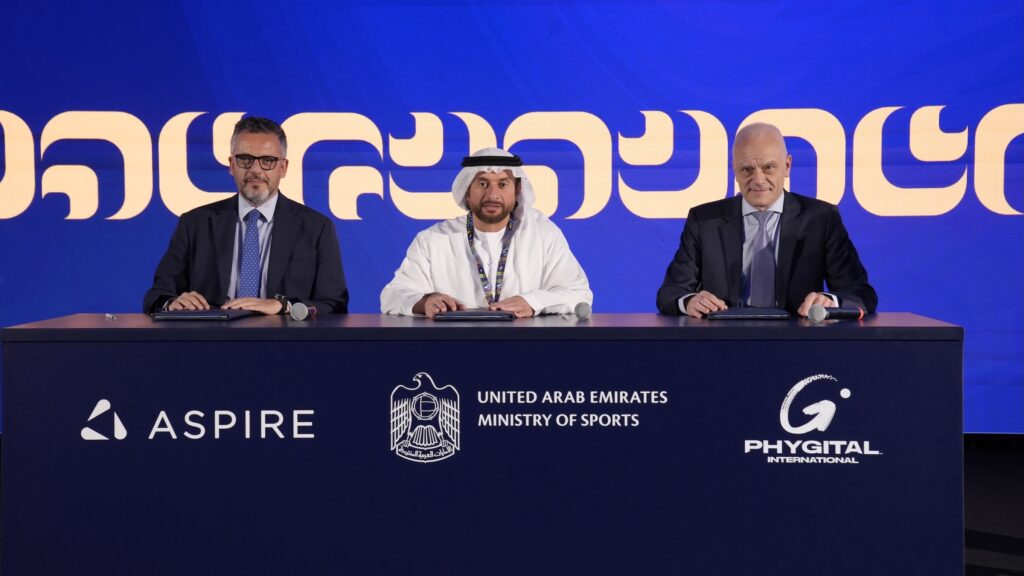
The MoU was signed by His Excellency Sheikh Suhail bin Butti Al Maktoum, Assistant Undersecretary for the Sports Development and Competitiveness Sector at the Ministry of Sports. The agreement aims to align national policy, innovation, and international visibility, reinforcing the UAE’s positioning at the forefront of future sport.
“This MoU builds on the success of the Games of the Future 2025 hosted by Abu Dhabi, supported by our wise leadership and marked by the presence of His Highness Sheikh Mohamed bin Zayed Al Nahyan, President of the UAE,” said H.E. Sheikh Suhail bin Butti Al Maktoum. “It reflects our vision at the Ministry of Sports to establish an integrated and sustainable framework for phygital sports that combines innovation, technology, and structured athlete development pathways.”
He added: “Through these strategic partnerships, we aim to reinforce the UAE’s global standing in future sports by aligning phygital initiatives with the National Sports Strategy 2031, enhancing innovation, empowering youth, and strengthening international cooperation across the phygital sports ecosystem.”
ASPIRE CEO Stephane Timpano described the agreement as a defining moment for the sector. “This partnership is about institutionalising the future of sport,” he said. “By combining technology, performance, and human potential, and building on the momentum of the Games of the Future 2025, the UAE is positioning itself as a global testbed for next-generation sports and talent development – and signing with the Ministry of Sport represents the next level of progress.”
Nis Hatt, CEO of Phygital International, added: “This collaboration reflects our shared belief that the future of sport lies at the intersection of physical performance, digital innovation, and human potential. By working alongside ASPIRE and the UAE Ministry of Sport, we are strengthening a global phygital ecosystem that advances innovation, nurtures emerging talent, and supports the sustainable growth of phygital sport worldwide.”
The MoU outlines several potential areas of collaboration, including hosting recurring international editions of the Games of the Future in the UAE, establishing long-term athlete pathways, and delivering an international summit focused on future sport governance and innovation. Plans also include the development of a nationwide network of phygital centres to support youth programmes, referee development, community competitions, and qualification pathways.
A key pillar of the agreement is the establishment of HITS Hub (High Innovative Tech Sports), a national research, development, and innovation centre dedicated to phygital sports technologies. The hub will support intellectual property development, testing of emerging disciplines, and serve as an operational base for future events.
Under the framework, ASPIRE will lead national coordination and strategic integration, leveraging its role within the ATRC innovation ecosystem to support sustainable legacy programmes. Phygital International will provide the Games of the Future intellectual property, technical standards, and discipline expertise, while the Ministry of Sports will ensure alignment with national sports policy, athlete development pathways, and approved standards, while promoting innovation and international cooperation in future sport.